Thursday, October 11, 2018

Perito Moreno Glacier!

I learned about the glaciers in Argentina after one of my friends took an around-the-world trip more than a decade ago. I'm not sure exactly which glacier/s he visited in Argentina but his stories piqued my interest enough to do my own research. It was then that I learned about Perito Moreno.


Perito Moreno is located in Parque Nacional Los Glaciares (Los Glaciares National Park), which was declared by UNESCO in 1981 to be a World Heritage Site. It is unique for being one of only three glaciers in the world that are advancing (almost all other glaciers are retreating). It is also one of the most accessible glaciers, making it a very popular tourist destination.


While searching for tours to include in our itinerary, I discovered that there is an option to do a mini-trekking tour on the glacier. I asked my mom if she wanted to do it and she said yes. Perfect! Our tour of Perito Moreno was a whole day affair. We did the mini-trekking in the morning until lunch time and we went to the main viewing point to see the massive facade of the glacier in the afternoon.


Our mini-trekking tour was organized by Hielo y Aventura. We were picked up at our hotel and taken to Parque Nacional Los Glaciares. There, we boarded a boat that brought us to the south side of the glacier.


Before starting our adventure, our guide gave us a short talk about glaciers. The guides then put on our crampons which are devices that help prevent us from slipping on the ice. After a few instructions on how to safely walk with our crampons, we were off!


Walking on the ice takes a bit of getting used to because initially, you are afraid that you might slip. It doesn't take too long though before you get used to it and then moving around the glacier becomes pretty manageable.


The mini-trekking part of tour took 1 1/2 hours. In that time, we walked around a section of the glacier and we got to see crevasses and incredible ice formations. We also got to walk through small gullies. It was exhilarating!


We were advised by the guide who picked us up at airport the day before to bring a water bottle during our mini-trek. This is so that we could more easily drink the glacial water when the opportunity presented itself. When we stopped in front of a small lagoon, our mini-trek guide told us we could drink the water if we wanted to. Of course, my mom and I did. It was very cold and refreshing!


As if the mini-trekking experience by itself wasn't enough, towards the end of the tour and while still on the glacier, we got to enjoy some whisky and chocolates. Awesome!


It didn't stop there. Once we took off our crampons, we went into a cave beneath the glacier. Sunlight pierced the translucent icy ceiling of the cave, giving it a gorgeous blue glow.


We then had our lunch break. You need to bring your own lunch because there is no place to buy food at the mini-trekking rest area (our lunch was included in our tour package and it was delivered to our hotel before our tour bus picked us up). After lunch, we boarded the boat then got on the bus that took us to the main viewing area in the National Park.


This is where most tourists go to see Perito Moreno. There is a network of walkways with multiple viewing decks that give visitors a chance to look at the glacier from many different levels and distances from the facade.


Throughout the day, there had been many glacial ruptures, where chunks of ice fall off, generating a loud booming sound. Our guide explained that these ruptures are due to the constant movement of the ice and not because of global warming. Interestingly enough, as I was having my photo taken, there was a rupture. I turned around and pointed at it, but you can't quite see it well enough in this photo (it is behind the leftmost fence post)


We still kept hearing booming sounds so I thought that if I remained patient, I would get an opportunity to see another rupture and even catch it on camera. As luck would have it, I did and amazingly enough, I was able to capture it on video. Check it our here:


I was actually worried that it would rain that day because the weather report said it would. Fortunately for us, the weather remained cooperative while we were touring and it was only when we were safely in our bus heading back to El Calafate that it started to rain. Talk about being lucky! (I guess we were due some good luck after getting drenched in Iguazu Falls.)


After this mini-trekking experience, my mom and I still had two more days left in South America but those were transit days to get us back home (we flew from El Calafate to Buenos Aires the next day and from Buenos Aires to Lima the day after). As such, Perito Moreno was our last tour day. I have to say, it was the perfect ending because we had a full day packed with an incredible variety of amazing and very memorable experiences.


While this is the last post about the tours that we took and the sights we saw and experienced, I will still be writing several more posts about my South America trip.


Next: South American Wildlife

Monday, October 08, 2018

El Calafate and Patagonia, Argentina

El Calafate is a city in the southern part of Argentina. It serves as the gateway to Perito Moreno Glacier and Los Glaciares National Park. The interesting thing is that I didn't know until shortly before my trip that I would actually get to set foot in Patagonia. I learned this when a friend asked me if Patagonia was part of my itinerary. I said that it wasn't but his question made me think about it so I did a quick search and I learned that El Calafate is indeed in Patagonia. Cool! Upon arriving at the airport on our first day, we were greeted by a fantastic sunrise. However, I only noticed the sunrise once we were in our transport but I was too sleepy to try and take a decent photo of it from inside the van so I thought that maybe I could just try to catch the sunrise the next day. Thankfully, I did. We were actually on our way to Perito Moreno Glacier when I saw this gorgeous sunrise from inside the bus. As I was trying to take a decent photo, our driver parked the bus on the side of the road and gave everyone several minutes to take photos. I have to say, this is quite possibly the best sunrise I've ever seen. It was magnificent!

Sunrise in Patagonia

El Calafate borders Lake Argentino, the biggest freshwater lake in Argentina. There is a great view of this lake from the airport.

Lake Argentino as seen from the airport

This city is very idyllic and charming. My mom said that it reminded her of Scandinavia.


I love the low-rise wooden structures that can be found all over the city.


We stayed at Kosten Aike Hotel, which is a lovely hotel with excellent service. We got there at around 9AM and the lady at the reception told us we could already check in even if it was several hours before the normal check-in time of 2PM. She also told us that we could already have buffet breakfast for free and she would have our luggage brought up to our room while we ate. Talk about great service! (Read my full review of Kosten Aike on tripadvisor in this link.)

Kosten Aike Hotel

After getting settled in our room, we decided to walk over to the main road of El Calafate, which was only two blocks from our hotel. We spent that time shopping for souvenirs and enjoying the wonderful and serene atmosphere.


My mom rested after lunch because she didn't get any sleep the night before so I went out on my own in the afternoon. I had initially planned to walk to the Laguna Nimez Reserve which was not that far from the city center. Unfortunately, there was something going on along the road to the nature reserve and the path was cordoned off. I don't know if there was a person being arrested or if there was a VIP in the area or if there was some other reason. I decided to try and take an alternate route using google maps but it was telling me to pass through what seemed like private property. I decided to give up on my plans to visit Laguna Nimez and I just headed back to the main road of El Calafate where I had coffee and a waffle in Abuela Goye. I think I got a banana hazelnut waffle and it was very, very good! The coffee was good too. (Read my review of Abuela Goye on tripadvisor in this link.)

Waffle and coffee at Abuela Goye

We were at the tail-end of an amazing but physically exhausting 17-day tour so we no longer headed out at night and we just had dinner at our hotel. The dinner menu is limited but we weren't too picky so it worked out well enough for us. The woman who took our orders and served our food was very friendly and pleasant.

Common area next to the lobby of Kosten Aike hotel where people can have dinner

There was only one tour left for us to take during our South America trip: a visit to Perito Moreno Glacier.

Next: Perito Moreno Glacier

Thursday, October 04, 2018

Buenos Aires, Argentina

Buenos Aires was our next stop after Iguazu. Our planned activities in this capital of Argentina were scheduled the next day so we had a free afternoon to explore the city. After exchanging money and having a late lunch, we went around the area near our hotel and found ourselves in Plaza de Mayo, the main square of Buenos Aires. On the far end of the plaza is Casa Rosada, which translates to Pink House. It is the executive mansion and office of the President of Argentina. Interestingly enough, Plaza de Mayo was the first stop on our tour the next morning. Our guide told us that it was in the balcony of Casa Rosada where Evita Peron famously stood and made her speeches to the Argentinian masses.

Casa Rosada

In the middle of the square is Pirámide de Mayo. This monumemt was built in 1811 to commemorate the first anniversary of the Revolución de Mayo, the first successful revolution of South America against Spain..

Pirámide de Mayo

Our guide pointed out another important building in Plaza de Mayo - the Buenos Aires Metropolitan Cathedral. This is where Pope Francis used to celebrate mass as Archbishop Jorge Bergoglio before he became the Pope. If our guide didn't tell us this building was a cathedral, I would have thought it was a government building.

Buenos Aires Metropolitan Cathedral

Our next stop was La Boca. This neighborhood is popular for its colorful houses that were often made from ship building materials, such as planks and corrugated iron. Caminito Street is a short alley and a street museum in La Boca that is lined with brightly colored buildings and a lot of sculptures.

Caminito Street in La Boca

At one end of Caminito Street is this monument to General José de San Martín, who liberated Argentina, Chile, and Peru from Spanish rule. He is celebrated all throughout South America and is a national hero in Argentina and in Peru.

General José de San Martín Monument in Caminito Street

We got to see a few more sights while on the road in our tour bus. The first was La Bombonera, the stadium of Club Atlético Boca Juniors which is the most successful football team in Argentina. Our guide told us that the colors of Boca Juniors were chosen because when the Club was unsure what colors to use for their kit, they decided to just adopt the colors of the flag of the first boat to sail into the port at La Boca. As it turned out, it was a Swedish ship. So Boca Juniors selected yellow and blue as their official colors.

La Bombonera, home stadium of Boca Juniors

Another landmark we saw while on the bus was Floralis Generica, a giant mechanical flower in Plaza de las Naciones Unidas. It opens during the day and closes at the night. This sculpture was a gift to Buenos Aires by architect Eduardo Catalano. (Side note: an additional cool thing about our tour was that many times when we would pass by a landmark that our guide pointed out to us, the bus we stop and driver would open the door so that we could take better photos.)

Floralis Generica

Our final stop that morning was La Recoleta Cemetery where you can find graves of many notable Argentines , including past presidents, military officers, renowned artists, scientists, athletes, and prominent families.

La Recoleta Cemetery

It was hailed by both BBC and CNN as one of the most beautiful cemeteries in the world. I actually told our guide that it felt like we were in an outdoor museum, what with all the beautiful and elaborate sculptures and mausoleums.


Arguably the most popular tomb in the entire cemetery is the Duarte family mausoleum.

Duarte Family Tomb

Why is it famous? It is because Eva María Duarte de Perón, or Evita Peron, is buried here.

Burial site of Evita Peron

There are a lot of other interesting places to visit in the Recoleta neighborhood but we had a big night to prepare for so my mom and returned to our hotel, had a late lunch nearby, and walked over to Florida Street where our tour guide said there would be many souvenir shops (there were). After buying several souvenirs, we headed back to our hotel to pack - we had a very early flight the next morning - and to prepare for dinner. But not before taking a few more photos along Florida Street...


...and near our hotel. Across the street from our hotel was the Basilica Nuestra Senora del Rosario (Basilica of Our Lady of the Rosary and Convent of Santo Domingo). The huge structure in front of the basilica seems to be the Mausoleum of Manuel Belgrano.

Mausoleum of Manuel Belgrano at the Basilica Nuestra Senora del Rosario 

As mentioned, my mom and I had a big night that night because included in our tour was a dinner and tango show at La Ventana Barrio de Tango.

Dinner and Tango show at La Ventana

Our dinner here was the fanciest meal we had during our tour of South America. Our package included a bottle of wine (I had most of it because my mom had only one glass)...


...and a three-course dinner, the highlight of which was a 300-gram steak that was very good. (I'm happy that I got to try a steak while I was in Argentina. :))


The tango show started a little after 10pm and ran for almost an hour and a half. I have to say, it was truly sensational! It is marketed as a tango show and there were several Argentine Tango numbers performed by three dance couples. But beyond that, the show also featured many other artists. First, the music was played by live musicians. There were also two singers - a male and a female, both incredibly talented - who serenaded the audience with their amazing voices. There was an artist who played what I think was a banjo or some stringed instrument. Not only was he astoundingly good, he also performed with such a fiery passion and energy that the audience was just absolutely awe-struck and captivated throughout his performance. Finally, there was a performer who started playing a drum before showcasing his amazing skills with bolas. He twirled a pair of bolas and played them as musical instruments, hitting them against the ground to produce a percussive beat that was perfectly timed with the music. (This is similar to the Boleadoras number performed in the Cirque du Soleil show Saltimbanco.) By the end of the show, everyone in the audience was on their feet to give the performers a well-deserved standing ovation. It was an expensive experience but it was definitely worth it because our food was great, the service was excellent, and the show was superb.


It was around 11:30PM when the show ended and it was close to midnight when we got back to our hotel. Our flight to El Calafate was at 5:35AM which meant that we needed to leave our hotel at around 3AM. This further meant that we had to be up at 2AM to get ready. Definitely not an easy schedule, especially considering I had more than half a bottle of wine LOL, but thankfully we did manage to wake up on time.

Next: El Calafate and Patagonia, Argentina

Sunday, September 30, 2018

Iguassu/Iguazu Falls

I learned about Iguaçu/Iguazú Falls thirteen years ago during my first visit - a business trip - to Brazil. I used to buy travel books of the countries I went to so when my business trip to Brazil was confirmed, I bought a Rough Guides book to give me an idea of what sights I could see while I was there. It was in this book that I first saw a photo of Iguaçu Falls. The moment I saw that photo, I immediately knew I had to visit this place.

Devils' Throat in Iguassu Falls, Brazil side

Iguassu/Iguazu Falls, which was voted as one of the New 7 Wonders of Nature, is actually on the border of Argentina and Brazil. It is spelled Iguaçu or Iguassu in Brazil (I assume this is the Portuguese spelling) and Iguazú in Argentina (I assume this is the Spanish spelling). 80% of the falls is on the Argentina side but being on the Brazil side gives you a panoramic view of the falls. I figured that if I were to visit Iguassu, I should visit both sides. Our tour allowed us to do just that.

More of Devils' Throat

BRAZIL SIDE

Upon arrival at the airport, our tour guide picked us up and took us straight to Iguaçu National Park. When our tour officially began, my initial reaction was that of disappointment. There didn't seem to be a lot of water. Based on pictures I've seen in my book and online, I was expecting water to be pouring over the entire ridge. Unfortunately, that wasn't the case when we were there. I kept my disappointment to myself since I wasn't sure if my mom had any expectations of what to see here and I didn't want to douse her enthusiasm.


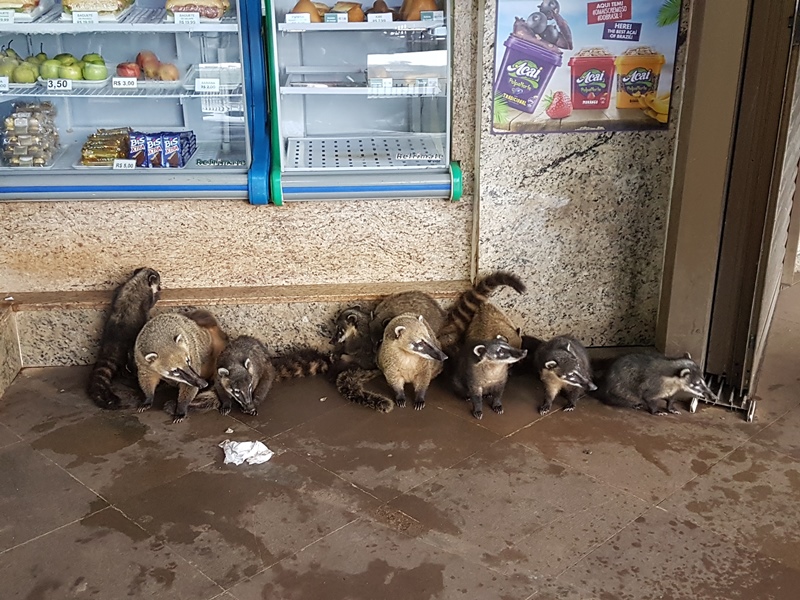
As we walked along the tour path, we saw several free-roaming coatis or coatimundis, which are members of the raccoon family and are native to South America. Seeing them actually lifted my spirits quite a bit. :)

coatis or coatimundis

As we got closer to Devil's Throat, which is the tallest part of Iguassu and where I think the largest volume of water courses through, my disappointment immediately turned into excitement. Even from afar, I could feel the power of the falls!


There are a series of walkways that allow visitors to get closer to Devil's Throat and have a much better view of it.


It started to rain but at that point, I didn't care. The views here were simply magnificent!


I took several photos under the rain before heading for cover. I wasn't the only one with that idea; there were several coatis also taking shelter.


The rain started getting stronger so even if we had just been in Iguassu for about an hour, we decided to leave and check into our hotel. Of course, before we left, I course had to have my photo taken a few more times. :)


ARGENTINA SIDE

The great thing about our private tour was that it took us through the Brazil-Argentina border via car. This made the logistics of our trip a whole a lot easier since we didn't have to worry about our luggage. We checked out of our hotel on the Brazil side, got picked up by our tour guide and the driver, put all our luggage in the car, got driven through the border, were taken to Iguazu Falls, and then driven to our hotel in Argentina afterwards. The downside was that the rain was a lot heavier on the second day.


We took a train to the entrance of Garganta del Diablo or Devil's Throat on the Argentina side. Once we got off the train, we walked for about 1.1 kilometers on a series of walkways over the Iguazu River. That 15-minute walk was well worth it because it allowed us to stand right over the mouth of Garganta del Diablo to catch some spectacular views!

Garganta del Diablo, or Devil's Throat, on the Argentina side

Standing over these majestic falls was just a truly incredible experience! Despite the rain, there were many people there. And amidst the crowd, we still managed to take some decent pictures.


For the first time, I got to use the waterproof camera I bought a few years ago. I decided to bring it because I read that there is always a spray of water at Devil's Throat and I didn't want my main camera to get wet.


In retrospect, I should have just used my camera phone. The problem with my waterproof camera was that the rainwater stayed on the lens and distorted the images somewhat. Nevertheless, I am happy that we were able to capture some very memorable moments, distortion notwithstanding.


Normally, after visiting Garganta del Diablo, visitors take a walk on the upper circuit and on the lower circuit for a complete experience of a trip to Iguazu. However, because it was raining hard, our guide said we shouldn't or couldn't go down the lower circuit anymore. Our tour was then limited to the upper circuit. We walked a short distance along the upper circuit and took a few photos before we decided to cut our tour short and just head to our hotel.

View from the upper circuit of Iguazu Falls on the Argentina side

The rain continued throughout the entire afternoon. My mom and I could have braved the rains and taken a taxi to the city center of Puerto Iguazu. I really wanted to visit the Triple Frontier Landmark which marks the border of three countries: Argentina, Paraguay, and Brazil. (Our hotel was maybe 20 minutes away from the center via taxi). However, if we did that, we would have gotten even more wet and we wouldn't have been able to dry our shoes and our clothes. It would be tough to pack wet clothes and wear wet shoes, especially considering our flight to Buenos Aires was the next morning. As such, we just stayed in our hotel, the Loi Suites Iguazú Hotel.

 Lobby of Loi Suites Iguazú Hotel

The other unfortunate thing was that we were unable to buy souvenirs from Iguassu/Iguazu. We didn't buy any at the Iguaçu National Park in Brazil because we thought we would have an opportunity to buy them at or near our the hotel or even the next day when we went to the Argentina side. Unfortunately, there weren't any souvenir shops in or near our hotel. We could've gotten souvenirs on the Argentina side but because we ended up being drenched, we just wanted to check into our hotel once our tour ended rather than spend time at the Iguazu souvenir shop. I also hoped that we could go to the city center and buy souvenirs there but alas, the rain kept pouring, making it very difficult to leave the hotel. The last remaining chance we had to buy souvenirs was at the airport but most of the items we saw there didn't appeal to us. The only souvenirs we were interested in were postcards but the shopkeeper told us that she didn't accept credit cards for postcard purchases. Unfortunately, we didn't have any local currency yet because we crossed the Brazil-Argentina border on the road and not through an airport so we didn't pass by any money exchange kiosks between Brazil and Argentina. And since the airport we were at was a local Argentina one, there were no currency exchange kiosks there either. (Our hotel also unfortunately didn't exchange money.)


Of course, the main purpose of this trip was to see Iguassu/Iguazu Falls and we did. This was a truly amazing and memorable experience.


Next: Buenos Aires, Argentina